Self-directed
Monte Carlo Options Pricer
derivatives pricing
HPC
Project overview
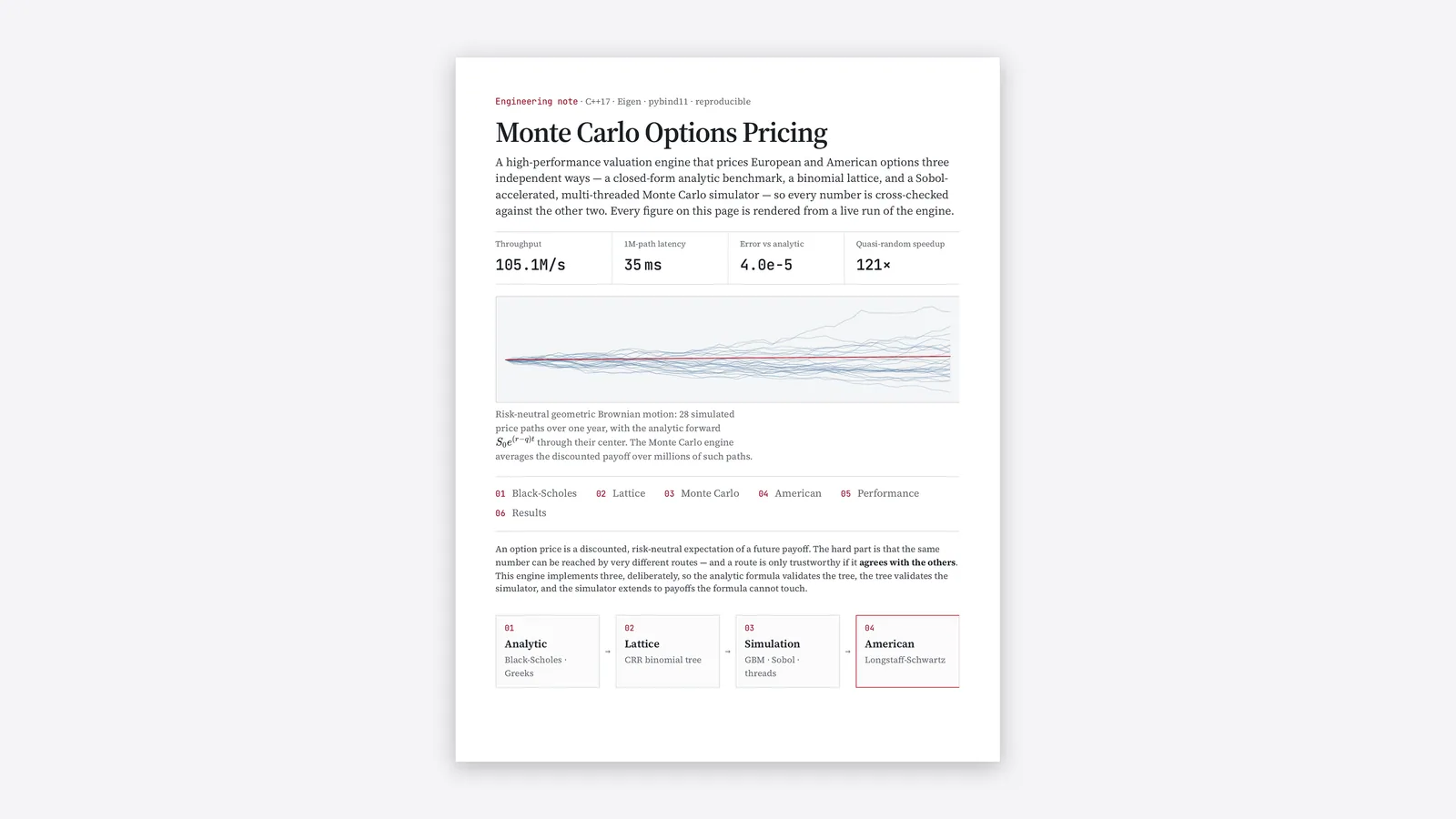
Three cross-validating C++ option-pricing engines
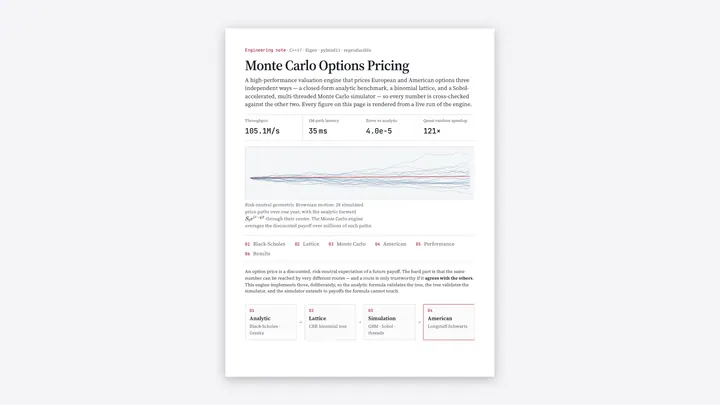
Prices European and American options three independent ways — Black–Scholes, a binomial tree, and a Sobol-accelerated Monte Carlo simulator — so every number is cross-checked against the other two.
Date
2026
Field
Quant
Stack
C++17, pybind11, Eigen, Python
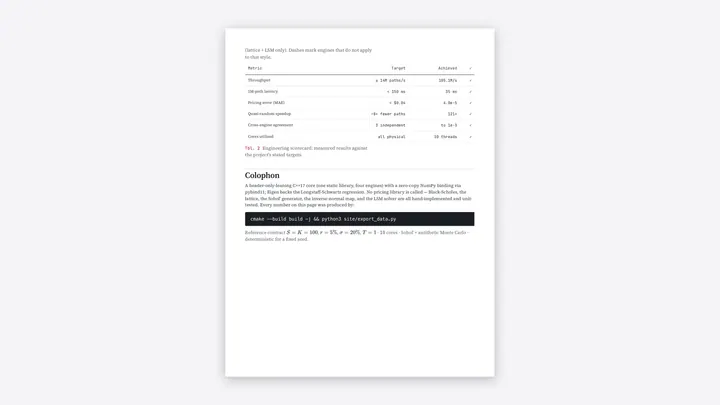
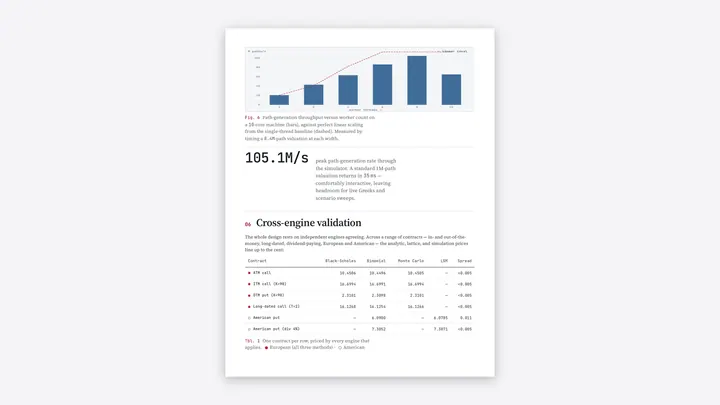
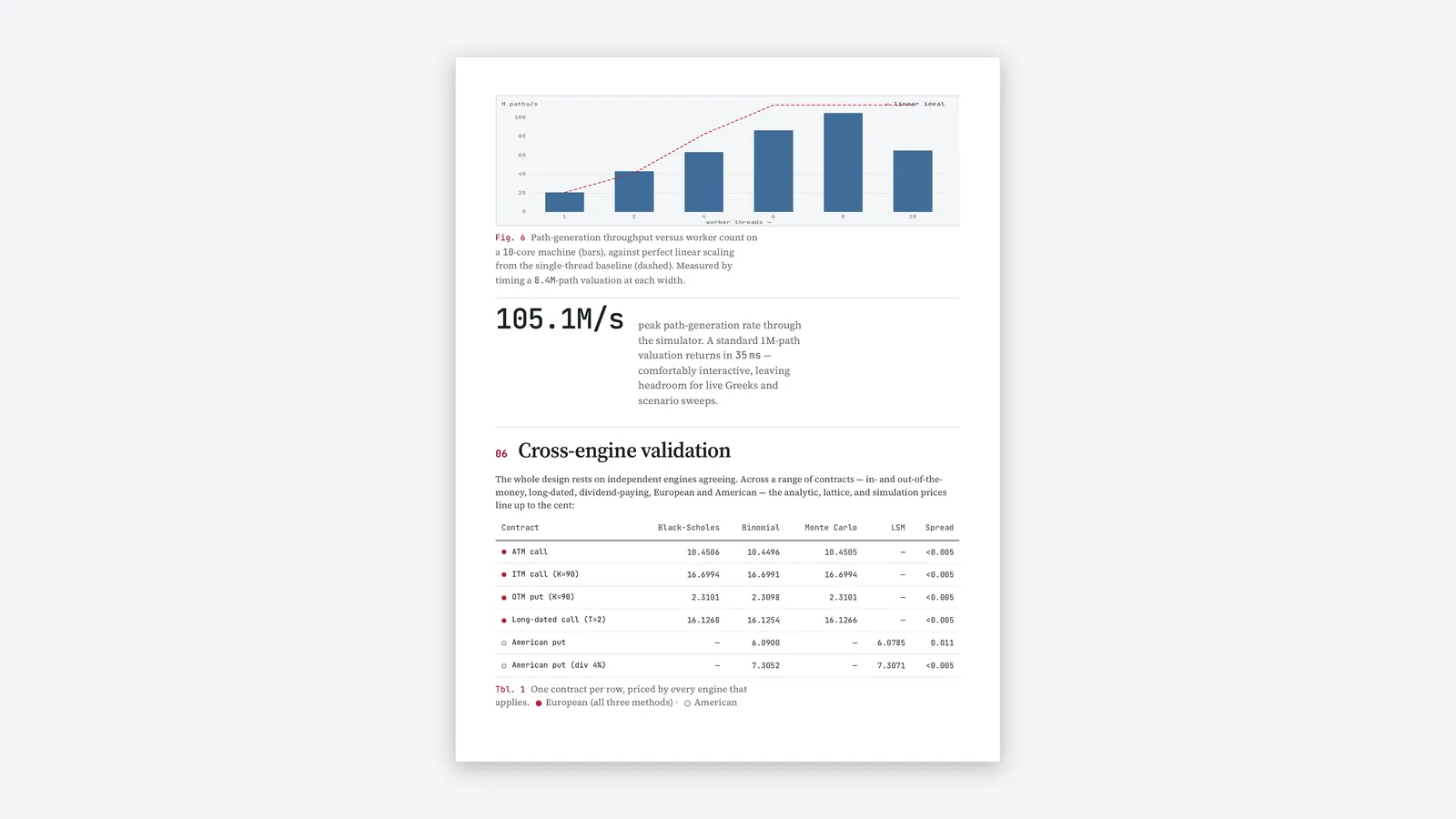
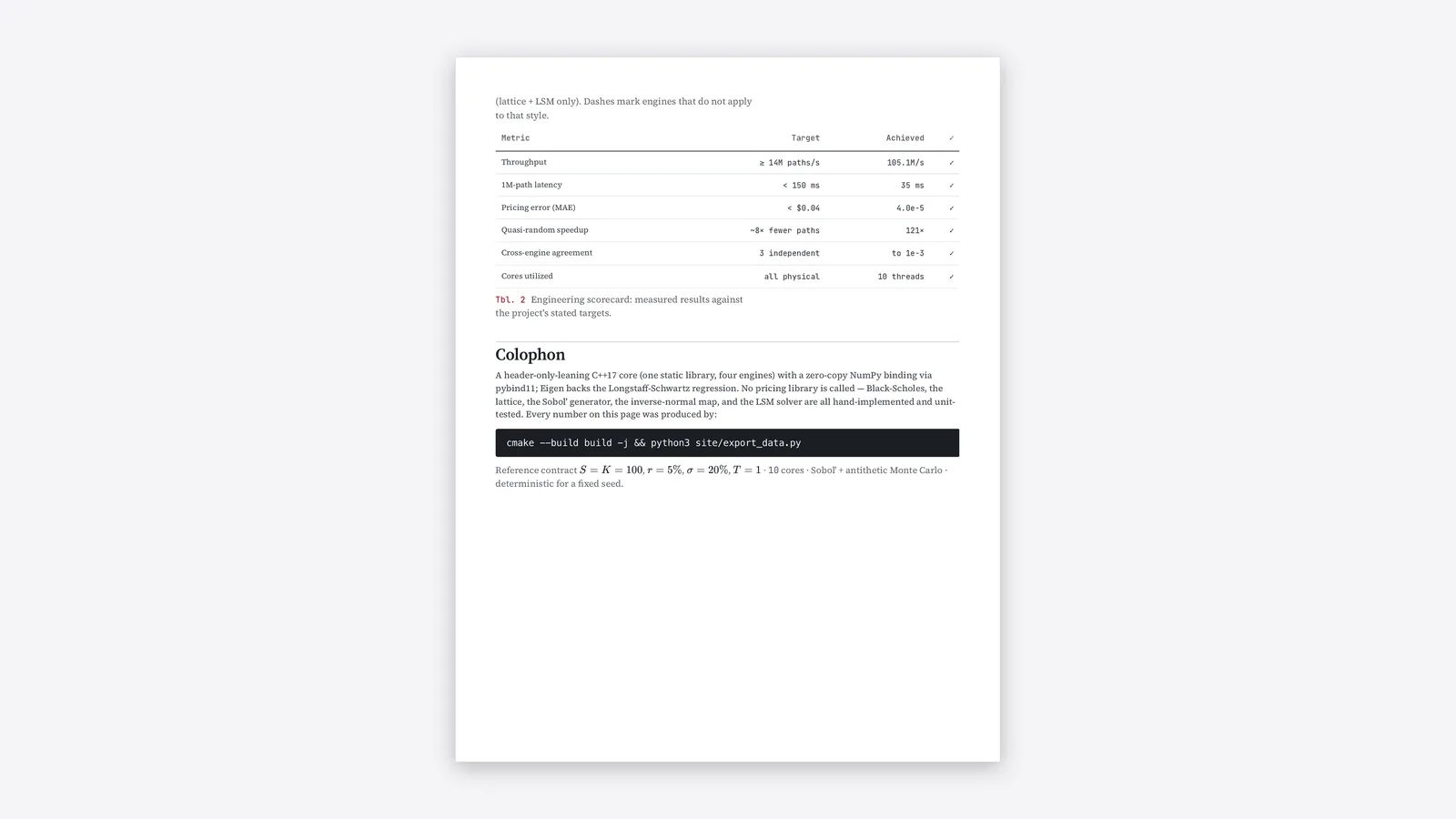
~105M paths/s
~1e-5 vs analytic
Sobol 6–55× variance cut
Context
A high-performance options pricing engine in C++17 with a pybind11 Python wrapper, where three paradigms that must agree are the core quality mechanism.

Monte Carlo Options Pricer
The hard part
An option price is only trustworthy if independent routes agree: the analytic formula validates the tree, the tree validates the simulator, and the simulator extends to payoffs the formula cannot touch.
What it took
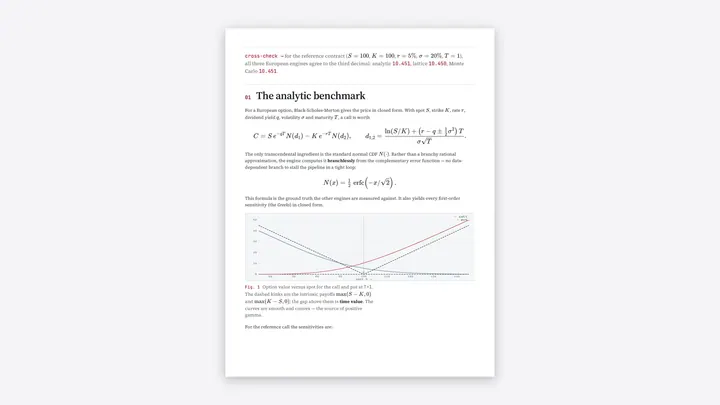
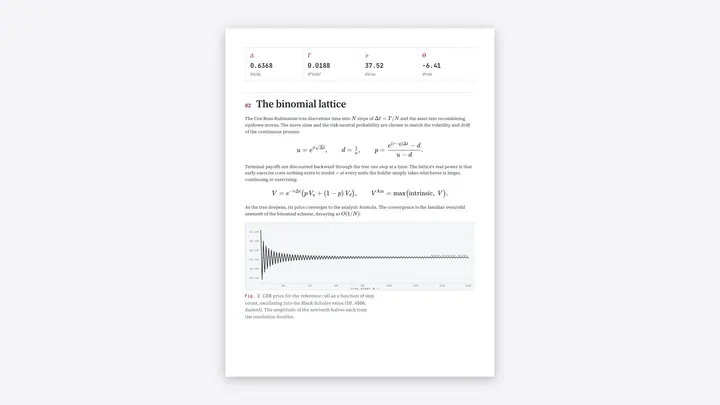
- Implemented closed-form Black–Scholes (price, Greeks, and a Newton + bisection implied vol), a CRR lattice with early exercise, and Monte Carlo over risk-neutral GBM, cross-validating to the cent across in/out-of-the-money, dividend-paying, European and American contracts.
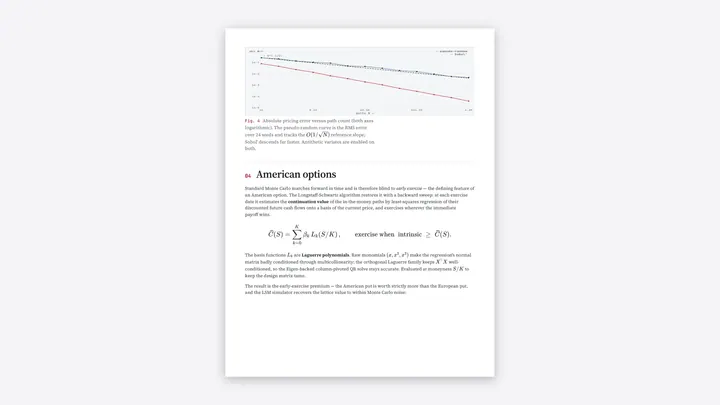
- Priced American options with the Longstaff–Schwartz least-squares method, regressing discounted future cash flows onto a Laguerre-polynomial basis at moneyness via Eigen's column-pivoted Householder QR for numerical stability.
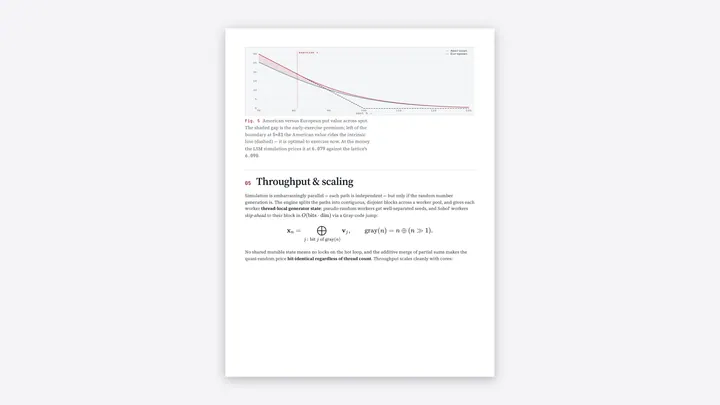
- Reduced variance with Sobol low-discrepancy sequences plus antithetic variates, and scaled throughput across a lock-free thread pool giving each worker thread-local RNG state (independent seeds or Sobol Gray-code skip-ahead) so quasi-random prices are bit-identical regardless of thread count.